Fan concept page: a what-if pitch, not a Microsoft product. VMX is an unofficial fan project, revealed Nov. 15, 2026. Not affiliated with or endorsed by Microsoft.
Manufacturer: VMX Studio
Release: In development
Type: Music
Plays on: Xbox and VMX
GROOVE on the Xbox.
GROOVE
A sing-along game made from the music you already own. The Xbox turns your songs into levels, you play the tune with the controller, and the VMX follows along when the song comes out of a speaker.
Levels from your own music: GROOVE finds the beat, the tune and the syllables of a song and makes a level for it.
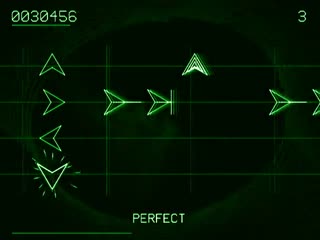
Tones and breaths: the D-pad is your voice, A is your lungs. Hold A through a breath and move the D-pad with the tune.
PHOSPHOR: a complex music visualizer that knows the song ahead of time, so it lands on the beat.
An editor: fix a level tone by tone, play a part again over the top, or whistle it in. (Whistling: PC build today.)
On the VMX: a level fits in about 3.6 KB, and the VMX listens to the music in the room and keeps the level in time. (In testing.)
Your songs stay yours. Levels hold timing only, never sound: nobody downloads songs, and no words are shown.
In development. The footage below is GROOVE's level builder as it runs today (PC build).
GROOVE's level builder (PC build), 56 s, with sound. Windows Media: 56K • 100K • 300K(MPEG-4 here)
About the video: a level's first phrase is played, then whistled in again. The whistle is a real recording, with no
backing track and a little fast: the builder finds its tempo, slides the notes onto the beat and gives each one a key.
Captured from the PC build, with the recording fed in as the microphone.
About the music: the tune is the "Ode to Joy" melody (Beethoven, 1824: public domain), arranged and played by a synthesizer
we wrote for this page; the level was made from that recording by GROOVE's own tools.
This track is a stand-in: it will be swapped for a rights-cleared song.
The cool stuff, and how far along it is. This part is about the real project as it stands in Nov. 2026.
Levels from your own songs
A level is made on the Xbox itself, from a song you own, while you watch. MAKE LEVEL reads the song once and works the
level out with plain signal processing: no neural networks, and nothing leaves the console.
Reading the song. The Xbox plays through the whole track faster than real time, measuring how loud it is and how
sharply the sound changes, 86 times a second.
Beats. From where the sound jumps it finds the tempo and places every beat.
The melody finder. For each moment it adds up the harmonics of every possible note and follows the strongest smooth
line through the full mix: what a person would hum, whether a singer or a guitar is leading. On the classic public test
sets (ADC2004 and MIREX05) the method finds the right pitch on about 85% and 83% of melody moments: more often than
Melodia, the long-standing reference system, run under the same test.
Syllables. Each sung onset becomes a note, its pitch read just after it starts and snapped to the song's key.
Phrases. Inside a phrase, a higher note sits higher on screen and the same note keeps its row, so a chorus plays the
same every time it comes back.
Three difficulties. Easy, Normal and Hard keep fewer or more of the same notes, so they all follow one tune, with ways to dial in your playstyle.
Tones and breaths
GROOVE plays like singing. The D-pad is your vocal cords: up, right, left and down are the tones, highest to lowest.
A is your lungs: press it to start a breath and hold it while the line runs, moving the D-pad as the tune moves.
A chain of tones on one press is one breath. Miss, and the beeper slides to a note that fits the chord instead of cutting out.
PHOSPHOR, the picture
The PHOSPHOR engine draws a visualizer like a green oscilloscope: glowing lines that are brightest where the beam moves slowly. Because the
level is worked out before you play, the picture knows what's coming: it swells on the beat, starts a change a bar early and
lands it on the downbeat. Each part of the song gets its own look (a tunnel, a figure, a wireframe city built one block a beat
that lifts over the rooftops in the chorus), and the background is held dim so the notes always stay the brightest thing on
screen.
A level in 3.6 KB
On the VMX a level is GV: one packed bit stream. Most of a level repeats itself (nearly every Hard note starts on a
melody note; Normal sits on Hard, Easy on Normal), so each difficulty is stored as which notes it keeps from the one above,
and every column of numbers gets the Rice code that makes it smallest. A level averages about 3.6 KB, under a quarter of the
Xbox's level file, so hundreds fit on a VMX.
The lock
A level made from your MP3 still has to line up with your CD, or with the song coming out of a radio. The lock does that from
the level alone: it listens for where the music gets louder and which notes sound, and matches them against the level's beats,
notes and chords. The notes tell one bar from the next, which beats alone can't do in music that repeats every bar. Once it has
the place it keeps following, and learns how fast or slow the music source runs.
Naming the song: landmark fingerprints
To know which song is playing, GROOVE uses landmarks: the loudest points of the sound's spectrum, paired up, each pair a short
number. A song's landmarks are made when its level is made. What the VMX hears through its microphone is
turned into landmarks the same way and looked up in a sorted table read straight from its memory.
GROOVE LIVE on the VMX (in testing)
Start GROOVE LIVE near the music and the VMX listens: it names the song, finds the place and plays the level in time, accounting for cuts, speed differences, and ambient noise and chatter.
GROOVE LIVE is currently being tested on a prototype VMX against its target in real rooms.
Beeper.Voice
The VMX's beeper has a mode specifically for singing, allowing for smoother gliding sounds, so a sung line comes out as a line, not a row of beeps.
C# in 128 KB
VMX games are C# 1.0, compiled by the ordinary C# compiler against a small .NET library of our own and run by a small interpreter
written in C: the same game file runs on the VMX, on the Xbox, on a PC, and in this browser. A game gets a 128 KB heap and 30
ticks a second. GROOVE's song search and lock all run inside that as managed code; only the microphone's FFTs and the table search are native.
This site is best viewed with Internet Explorer 5.5 or later at 800 x 600 or higher.
The demos also run in any current browser.
Get VMX
The VMX isn't for sale yet. We're looking for a partner to build it, with a Kickstarter as the backup.
Xbox Live launched Nov. 15, 2002. VMX scores go online from VMX World, or by phone from the VMX itself.
(Score service in development.)
About this page
A fan concept: what an Xbox memory unit with a screen might have looked like on launch day of
Xbox Live. Made by fans, with our own art. Not a Microsoft page.